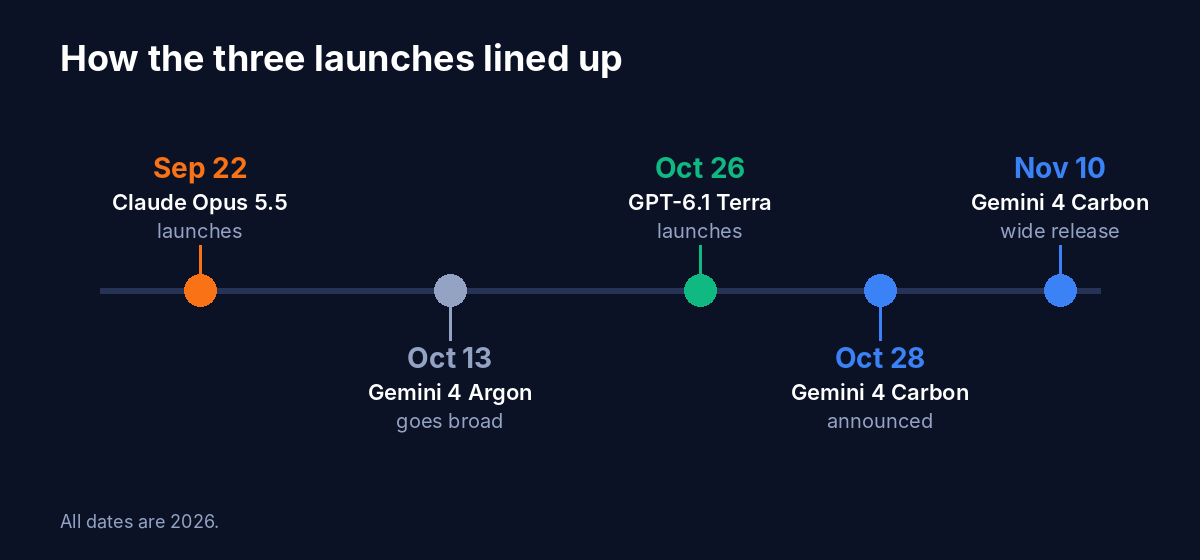
In the space of seven weeks, three of the biggest AI labs each shipped a model that wants to be your new default. Anthropic released Claude Opus 5.5 on September 22. OpenAI followed with GPT-6.1 Terra on October 26. Google then announced Gemini 4 Carbon on October 28 and opened it up widely on November 10. If you feel like the ground keeps moving, you are not imagining it.
The good news is that choosing between them is easier than the launch-day noise suggests. These models are built for different jobs and priced very differently. This guide breaks down what each one does well, what it costs, where the claims need a grain of salt, and which one fits your work.
The Quick Answer
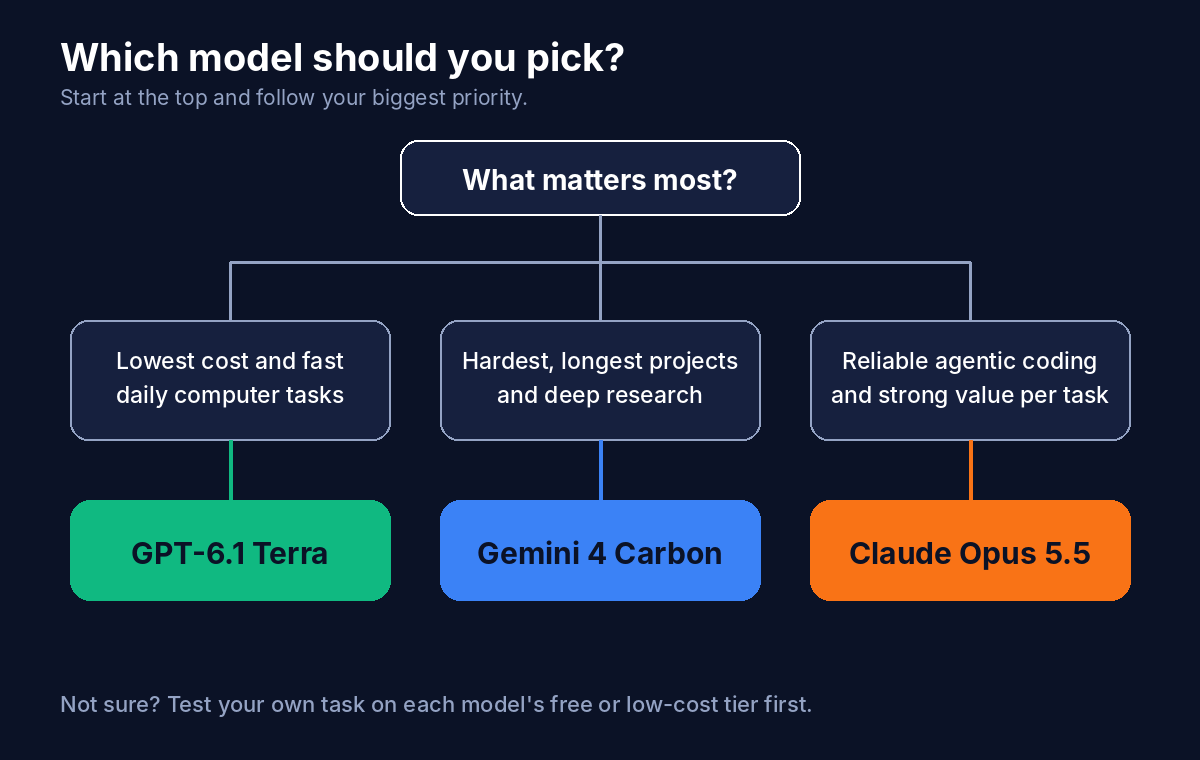
- Pick GPT-6.1 Terra if you want the lowest price and fast, capable help with everyday computer work such as drafting, forms, spreadsheets and screen-based tasks.
- Pick Gemini 4 Carbon if you have your hardest, longest-running problems: deep debugging, scientific research, big knowledge-work projects and web development with rich visuals.
- Pick Claude Opus 5.5 if agentic coding, long multi-step tasks and strong value per finished task matter most to you.
If your budget is tight, start with Terra. If quality on difficult work is the priority, test Carbon and Opus 5.5 side by side on your own files before you commit.
First, an Honest Caveat: These Are Not the Same Tier
Most comparison posts line these three up as if they were identical products. They are not, and that matters for how you read every benchmark and price you see.
- GPT-6.1 Terra is the middle model in OpenAI's lineup. OpenAI's four model classes run from Luna (lowest price) through Terra and Sol to Astra (most capable). OpenAI itself still points users to Sol or Astra for its most complex coding work.
- Gemini 4 Carbon is Google's strongest model, positioned above Gemini 4 Argon.
- Claude Opus 5.5 is Anthropic's flagship general-release Opus model, although Anthropic also sells even higher tiers, and one independent index has placed a higher Claude model slightly ahead of Carbon.
So a fairer way to think about this is a mid-priced efficiency model, a top-end frontier model and a premium flagship, rather than a straight three-way race. That framing makes the pricing gaps below much easier to understand.
The Three Launches at a Glance
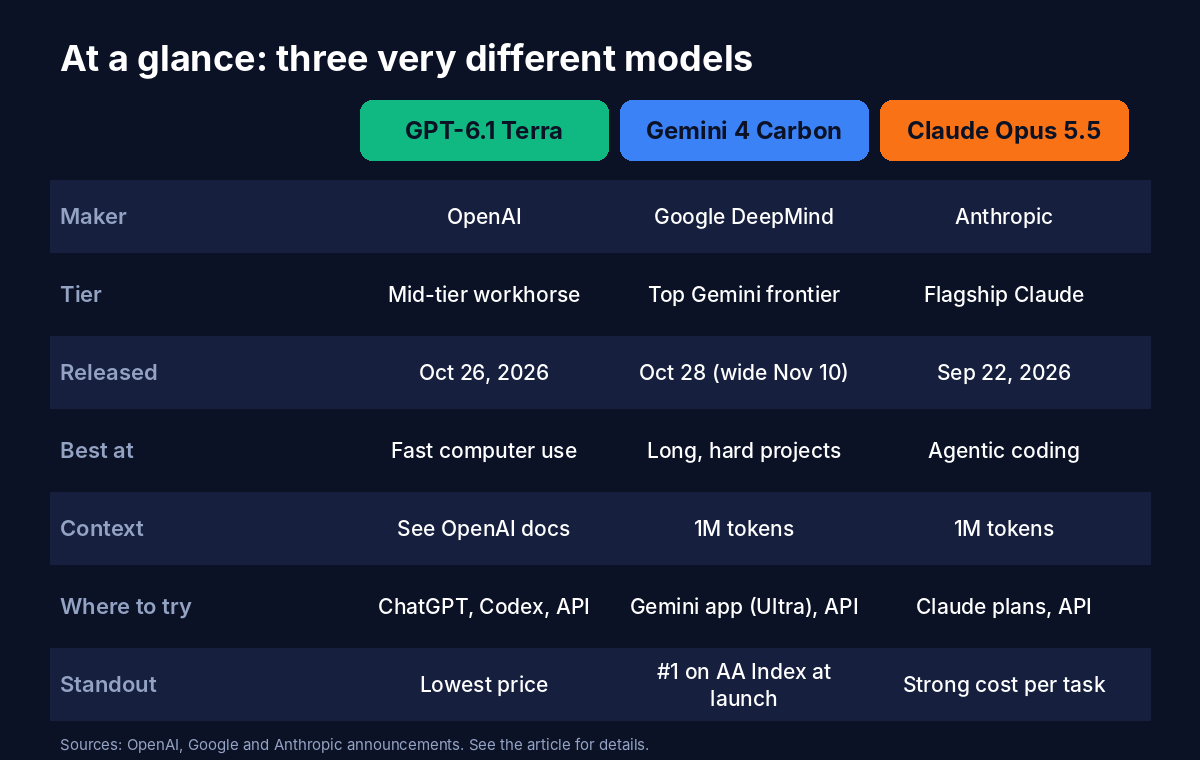
| Feature | GPT-6.1 Terra | Gemini 4 Carbon | Claude Opus 5.5 |
|---|---|---|---|
| Maker | OpenAI | Google DeepMind | Anthropic |
| Release | October 26, 2026 | Announced October 28, wide release November 10, 2026 | September 22, 2026 |
| Position in lineup | Mid-tier efficiency model | Top Gemini 4 model | Flagship Opus model |
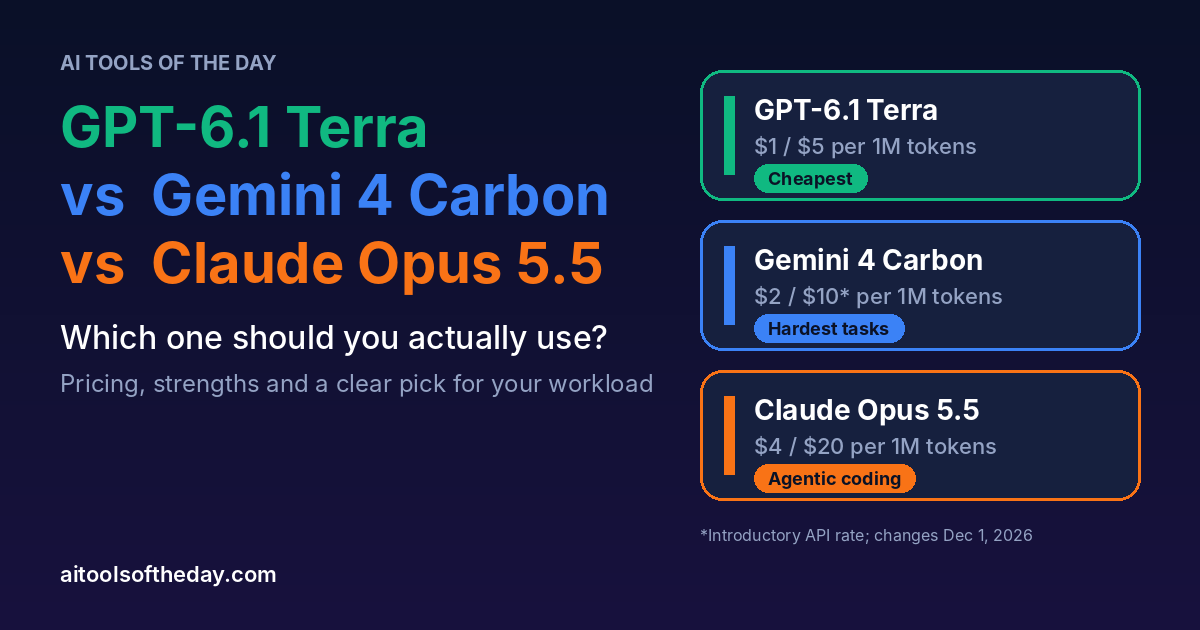
| API price (input / output per 1M tokens) | $1 / $5 | $2 / $10 introductory, reported to rise to $4 / $20 on December 1 | $4 / $20 |
| Context window | Check OpenAI's model page | Up to 1M tokens (input plus output) | 1M tokens |
| Headline strength | Fast, low-cost computer use and writing | Long-horizon engineering, research and web development | Agentic coding and cost per completed task |
| Where consumers can use it | ChatGPT Work and Codex (Plus, Pro, Enterprise, Edu) | Gemini app and AI Mode in Search (Google AI Ultra) | Paid Claude plans and Claude Code |
| API model name | gpt-6.1-terra | Via Google AI Studio and the Gemini API | claude-opus-5-5 |
GPT-6.1 Terra: The Budget-Friendly Workhorse
Terra is OpenAI's upgrade to its middle model, and the pitch is simple: do more of the workday for less money. OpenAI describes it as a model for tasks such as drafting proposals, reading technical drawings, filling out forms and editing video, with a focus on understanding what is on screen and taking action across apps.
What stands out
- Price. The API rate is $1 per million input tokens and $5 per million output tokens, with cached input at $0.05. OpenAI says that is 50% lower than the GPT-5.6 Terra model it replaces.
- Speed. OpenAI reports that Terra finishes tasks more than three times faster than its larger GPT-6 Astra and GPT-6.1 Sol models.
- Fewer factual slips. In OpenAI's own internal test at low reasoning effort, the error rate dropped from 53.6% to 16.7% compared with the previous Terra. That is a company-reported result, so treat it as a promising signal rather than a guarantee.
- Better coding than before. Terra scored 50.3% on Terminal-Bench 4.0 at maximum reasoning effort, up from 21.5% for its predecessor.
Where it falls short
Terra is not trying to be the smartest model in the room. OpenAI itself recommends its bigger models for the most demanding coding work. It is also limited to paying ChatGPT plans for the Work and Codex experiences, so free users will not see it there.
Best for
Students, freelancers, small teams and anyone automating repetitive screen-based work who wants strong results without a premium bill. If you are building a lean stack, browse our AI chatbots and assistants collection for alternatives that pair well with it.
Gemini 4 Carbon: Google's Heavy Hitter for Hard Problems
Carbon sits at the top of Google's Gemini 4 family. Google built it for what it calls long-horizon work: tasks that run for a long time, involve many steps and punish a model that cuts corners. Google says it can keep working through complex tasks for days without getting stuck or taking shortcuts.
What stands out
- Leaderboard position. At announcement, Carbon took first place on version 5.0 of the Artificial Analysis Intelligence Index with a score of 59. Leaderboards shift quickly, so check the current standings before quoting this.
- Web development. Google reports a jump of 89 Elo points to land fourth on WebDev Arena with a rating of 1769, helped by better-looking, more polished front-end output.
- Honesty improvements. Google says Carbon cuts unsupported claims by roughly half compared with Gemini 4 Argon, and that high-severity misalignment alerts in internal live coding dropped by almost 80%.
- Security work. The Chrome team reported that Carbon produced high-quality security patches more than ten times better than another lab's large frontier model. Because that skill cuts both ways, Google opened access to cyber defenders first through its Fairwind Program.
- Input flexibility. It accepts text, images, audio and video, with a combined context of up to one million tokens.
- Cost per task. According to coverage of the launch, Carbon ranked first on CursorBench 4.0, Perplexity's WANDR and Zapier's AutomationBench while costing less than half as much per task as the next best model from another company.
Where it falls short
Carbon thinks harder than Argon, which means it uses more tokens and can be slower on some requests. Google's own model card warns of occasional slowness or timeouts, especially at higher thinking levels. Google also says Argon remains the better everyday choice for most coding and office work, with Carbon reserved for tasks that push a model to its limits. Consumer access in the Gemini app requires a Google AI Ultra subscription.
Best for
Researchers, senior developers, data teams and anyone tackling a problem where being right matters more than being fast. If your work leans toward analysis, our AI research and data analysis tools page lists complementary options.
Claude Opus 5.5: The Agentic Coding Specialist With Strong Value
Anthropic's Opus 5.5 is the first model in its Claude 5.5 family. Its headline trick is not a higher sticker price but a lower one: Anthropic cut list pricing by about 20% versus Opus 5 and says the model uses fewer tokens to finish the same work, which it estimates adds up to roughly 40% lower cost per task.
What stands out
- Price. $4 per million input tokens and $20 per million output tokens, with cache reads at $0.20. A faster mode, available in Claude Code and on the developer platform, costs $8 and $40 and runs up to 2.5 times quicker.
- Agentic coding. In Anthropic's launch table, Opus 5.5 scored 66.4% on Terminal-Bench 4.0, ahead of the 57.9% it lists for GPT-6 Astra. Independent trackers that ran the test themselves reported somewhat lower numbers, so expect results to vary by setup.
- Strong independent rankings. At one snapshot, Opus 5.5 placed first on the Vals Index and led several individual leaderboards, including Terminal-Bench 2.1 and ProgramBench.
- Long context and adaptive thinking. It supports a one million token context window, with adaptive thinking always switched on.
Where it falls short
Its per-token price is the highest of the three today, and it is four times Terra's input price. Because it handles text and images but not video input, it is a weaker fit for video-heavy workflows. The cost-per-task advantage depends on your workload, so it is worth measuring on your own tasks.
Best for
Developers running coding agents, teams automating multi-step knowledge work and writers who prefer a more direct, less robotic tone. You can read more about it on our Claude listing, and see how it fits alongside other autonomous AI agents.
Pricing Compared: What You Will Actually Pay
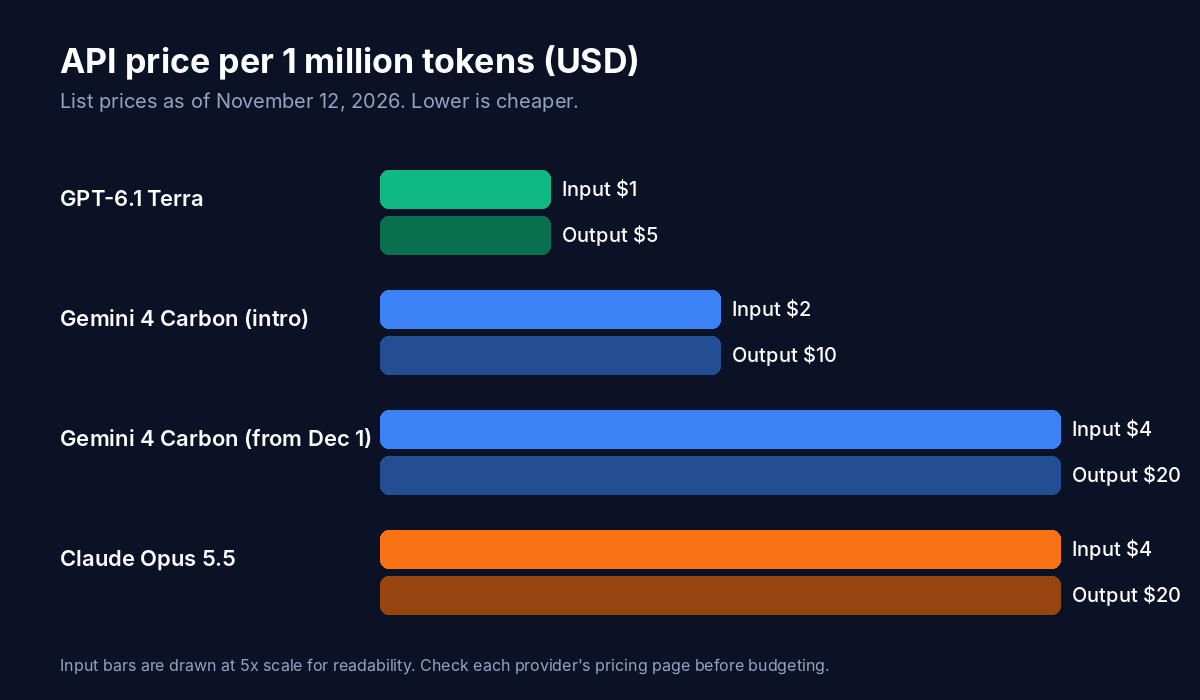
Per-token prices only tell part of the story, so here is a concrete example. Imagine a job that reads 1 million tokens and writes 200,000 tokens, which is roughly a large document set plus a long report.
| Model | Rate (input / output) | Cost of this example job |
|---|---|---|
| GPT-6.1 Terra | $1 / $5 | $2.00 |
| Gemini 4 Carbon (introductory) | $2 / $10 | $4.00 |
| Gemini 4 Carbon (after the introductory period) | $4 / $20 | $8.00 |
| Claude Opus 5.5 | $4 / $20 | $8.00 |
Three things to keep in mind:
- Carbon's price is temporary. Reports say its $2 and $10 rates match Argon's launch pricing and double on December 1, so budget at $4 and $20 for anything long term.
- Tokens used matters as much as token price. Carbon spends extra effort exploring and verifying, while Anthropic says Opus 5.5 finishes work with fewer tokens. A cheaper rate can still produce a bigger bill if the model needs far more tokens to finish.
- Subscriptions work differently. If you use the chat apps rather than the API, you pay a monthly plan fee and these per-token rates do not apply directly. Access also depends on your plan: Terra needs a paid ChatGPT tier, Carbon in the Gemini app needs Google AI Ultra, and Opus 5.5 is on paid Claude plans.
How Much Should You Trust the Benchmarks?
Every number in this article that comes from a lab's own announcement should be read as a marketing-adjacent claim until independent testers confirm it. Three reasons for caution:
- Different tests, different settings. The same benchmark can produce different scores depending on reasoning effort, tools allowed and who ran it. We saw this with Opus 5.5 on Terminal-Bench 4.0, where the lab's figure and independent figures differ.
- Different tiers. Comparing a mid-tier model with two flagship models on raw scores will naturally favor the flagships. Terra's appeal is value, not a leaderboard crown.
- Leaderboards move fast. A model that is first this week can be second next week when another release lands.
The most reliable test is your own work. Take three real tasks you do every week, run them on each model, and compare quality, speed and cost. That small experiment will tell you more than any chart.
Which Model Is Best for Your Use Case?
Everyday work and admin tasks
Choose GPT-6.1 Terra. Drafting emails, filling forms, summarizing documents and working across apps are exactly what it was tuned for, and the low price makes heavy daily use affordable.
Software development and coding agents
Choose between Claude Opus 5.5 and Gemini 4 Carbon. Opus 5.5 is built around agentic coding and strong value per finished task, while Carbon shines on deep debugging, secure code and long-running engineering projects. Many teams will end up using both, so check our AI code generation tools for the wider field.
Research, science and data analysis
Choose Gemini 4 Carbon. Google designed it for frontier discovery work and lets scientists apply for six months of free access through its Antigravity platform. For quick, sourced answers on the web, a dedicated search tool such as Perplexity AI can complement any of these models.
Writing and content creation
All three write well. Terra is the budget pick, and OpenAI highlights clearer, more natural writing in this release. Opus 5.5 is known for a direct, less "AI-sounding" voice. Browse our AI writing and content tools if you want specialist helpers on top of a general model.
Small businesses and solopreneurs on a budget
Start with Terra and add a premium model only for jobs that really need it. Our guide to the best AI tools for small business owners with no budget shows how to stretch free tiers first.
Side projects and income ideas
If you are exploring ways to earn with these tools, read our realistic guide to making money with AI tools in 2026 before spending on premium plans.
Pros and Cons Summary
| Model | Pros | Cons |
|---|---|---|
| GPT-6.1 Terra | Lowest price, fast, good computer use, fewer reported errors than its predecessor | Not OpenAI's strongest model; hardest coding tasks are better sent to larger models |
| Gemini 4 Carbon | Top-tier reasoning, long-horizon tasks, strong web development, multimodal input, large context | Uses more tokens, occasional slowness, consumer access needs an Ultra plan, introductory price ends soon |
| Claude Opus 5.5 | Strong agentic coding, good value per task, large context, direct writing style | Highest per-token price today, no video input |
How We Put This Guide Together
This comparison is built from official announcements, model documentation and independent trackers published through November 12, 2026. We did not run our own lab benchmarks, so we label every figure as reported by its source and point out where independent numbers differ. Prices and availability change often, especially around promotions, so confirm current rates on each provider's pricing page before you buy. We will update this article when anything significant changes.
Frequently Asked Questions
Which is better: GPT-6.1 Terra, Gemini 4 Carbon or Claude Opus 5.5?
There is no single winner. Terra wins on price and everyday speed, Carbon is aimed at the hardest long-running problems, and Opus 5.5 is a top choice for agentic coding and value per task. The right pick depends on your workload and budget.
Is GPT-6.1 Terra cheaper than Claude Opus 5.5?
Yes. Terra's API price is $1 per million input tokens and $5 per million output tokens, while Opus 5.5 costs $4 and $20. On a typical mixed job, Terra costs about a quarter as much per token, although total cost also depends on how many tokens each model uses.
How much does Gemini 4 Carbon cost?
At launch, Gemini 4 Carbon API pricing is $2 per million input tokens and $10 per million output tokens, matching Gemini 4 Argon. Reports say both rates double on December 1, 2026, to $4 and $20. In the Gemini app, access requires a Google AI Ultra subscription.
Can I use these models for free?
Not at full capability. Terra is available to paid ChatGPT plans in Work and Codex, Carbon in the Gemini app requires Google AI Ultra, and Opus 5.5 is offered on paid Claude plans. Free tiers from each company typically use smaller models, so check each service for current limits.
Which model is best for coding?
For agentic coding, Claude Opus 5.5 and Gemini 4 Carbon are the two strongest candidates here, with Carbon positioned for deep debugging and security work and Opus 5.5 for efficient multi-step agents. Terra is a budget-friendly option for lighter coding, but OpenAI recommends its larger models for the most complex work.
Which model is best for beginners?
Beginners usually do well starting with GPT-6.1 Terra because of its lower cost and focus on everyday tasks. Once you know what you need, trial a premium model for the jobs where quality matters most.
Should I switch models every time a new one launches?
No. Switching constantly wastes time. Pick a model that fits your workflow, re-test every few months on your real tasks, and move only when there is a clear gain in quality or cost.
Final Verdict
The smartest takeaway from this three-way launch is that "best AI model" is the wrong question. The better question is which model gives you the most useful finished work per dollar for the job in front of you.
- Budget and daily productivity: GPT-6.1 Terra.
- Toughest problems and research: Gemini 4 Carbon.
- Agentic coding and strong value per task: Claude Opus 5.5.
Run a small test on your own work, keep the winner and revisit in a few months. Ready to explore more? Browse the full AI tools directory, get ideas from the prompt library, catch the latest on our AI news page, or read more guides on the AI Tools of the Day blog. Building your own AI tool? You can submit it to our directory for free.
Sources and Further Reading
- Google: Gemini 4 Carbon announcement
- Google DeepMind: Gemini 4 Carbon model card
- Digital Trends: Gemini 4 Carbon now available
- BleepingComputer: OpenAI launches GPT-6.1 Terra
- 9to5Mac: OpenAI upgrades ChatGPT and Codex with GPT-6.1 Terra
- Technology.org: Claude Opus 5.5 launch, pricing and benchmarks
- Vals AI: Claude Opus 5.5 benchmarks and cost
- Android Authority: Gemini 4 Carbon rollout and pricing